Locksmith services are always 10% off for seniors.
Open Mon–Thu 8:30 AM–9 PM, Fri 8:30 AM–4 PM, Sun 9:30 AM–9 PM
Locksmith services are always 10% off for seniors.
Open Mon–Thu 8:30 AM–9 PM, Fri 8:30 AM–4 PM, Sun 9:30 AM–9 PM
GTA Lockman Mobile Locksmith Services · Toronto & GTA
Check the construction key arrangement, the strikes and the door fit before deciding what to change.
Related services
Choose compatible front-door hardware with the right fit, operation and finish for the existing opening.
Learn moreWhat Grade 1, 2 and 3 measure, what they leave out, and why the strike and frame often matter more.
Learn moreReduce the keys you carry where cylinders and access requirements allow a suitable keyed-alike arrangement.
Learn moreNew floors, paint, thresholds and weatherstripping move doors. Find the cause and restore reliable locking.
Learn moreKeep suitable hardware while changing which keys operate your new home’s locks.
Learn moreRepairs, rekeying and replacement hardware for homes, condos and apartments, with attention to the whole door.
Learn more
A newly built home arrives with locks already fitted, and most buyers never think about them again. They work, the keys turn, and the house is new. The hardware is still worth a look, for two reasons: the keys have been through many hands during construction, and builder-supplied hardware is usually chosen to a price.
Neither is a criticism of the builder. Trades need access while a house is being finished, and hardware is a small line in a large budget. It does mean that the locks on a new home are a starting point rather than a finished decision.
In a new home, the first week is for checking every door, understanding what the construction key system does, and deciding later which upgrades are worth making once you have lived in the house for a while.
During the build, framers, drywallers, painters, electricians, plumbers, flooring crews, inspectors and cleaners all need to get in. Many builders use a construction key arrangement, where a temporary key operates the locks until the homeowner's key is used for the first time, which cancels the construction key.
That system works when it is used properly. Ask your builder which arrangement was used, whether the construction key has been voided, and how many homeowner keys were cut. If the house was left on ordinary keys during construction, treat every copy as unaccounted for.
Turning the new homeowner key in each lock is often what voids the construction key, so do it at every door, not just the front. If you are unsure whether the system was used at all, rekeying removes the question; see rekey or replace.
Test each exterior door with the door closed. Close each door gently: a new door should latch without help, and the deadbolt should slide home with no need to lean on the door. New houses settle, and frames move as materials dry out, so a door that closed cleanly at handover can bind within months.
Check that every lock has been keyed to the same key, if that is what you expect. Builders sometimes fit a different cylinder on the garage entry or a side door.
Look at the strike plates. Builder installations frequently use short screws into the door casing rather than long screws reaching the wall framing. That single detail is the difference between a frame that resists a kick and one that splits.
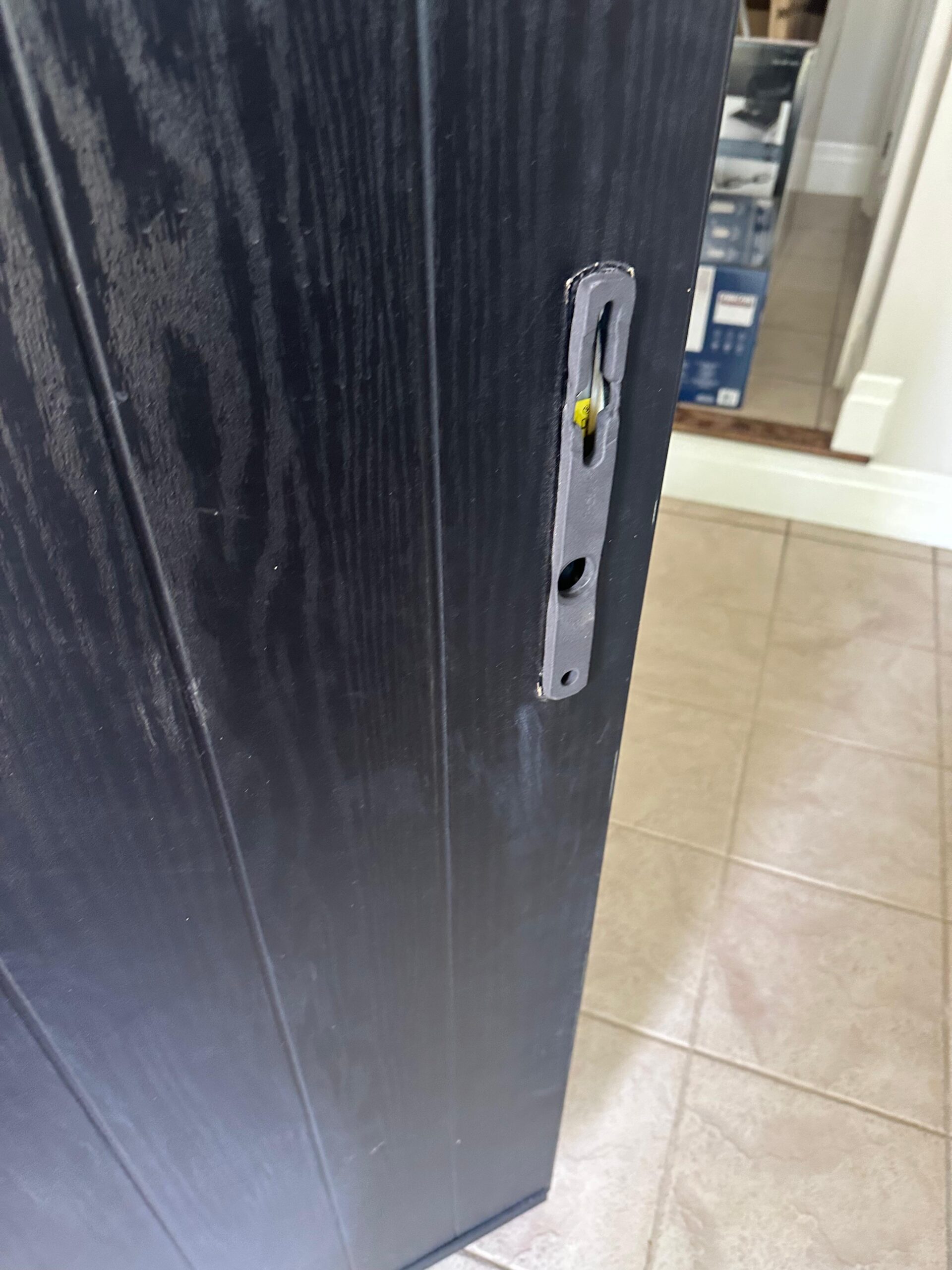
Hardware supplied with new homes is often Grade 3, the basic residential level. It works, and on an interior door it is perfectly reasonable. Builders often fit it because it meets the requirement at the lowest cost, and on a family's main entrance it tends to loosen within a few years.
Builder-grade hardware is often the lowest acceptable grade, and lock grades explained shows what each grade actually measures. If you decide to upgrade, the usual order is: correct the alignment, reinforce the strikes and hinges with long screws, then improve the hardware itself.
Upgrading does not mean replacing everything. Many households change the front and garage entry hardware and leave the rest, or simply add longer screws and a reinforced strike to every exterior door.
New houses move. Lumber dries, foundations settle and frames shift slightly through the first heating season. Doors that worked in June can drag in February. This is normal, and most of it is corrected by adjusting hinges and strikes rather than replacing hardware.
If your builder offers a warranty inspection at the end of the first year, note any door that sticks, any lock that needs force and any latch that misses, and raise them while the warranty applies. Settling is the usual cause of a front door that will not lock or a stuck deadbolt and door that will not open in a new house.
Garage entry doors move the most, because one side of the door is heated and the other is not. See garage-to-house door locks.
Many new homes come with a keypad deadbolt on the garage entry or the front door, and some are prewired for alarm or access equipment. Reset any device that was set up during construction: remove the builder or trade codes, set your own administrator code and test the mechanical override key.
If the house has a smart lock linked to an app, confirm the account is in your name and that no installer account remains. Clearing old device accounts is part of smart lock repair and troubleshooting, and changing codes is part of owning a keypad lock.
Many new homeowners have more work done in the first year: a deck, a fence, a finished basement, window coverings or landscaping. Each brings more trades and more temporary access.
Rather than handing out house keys, use a keypad code you can remove or arrange access for specific days. Temporary access works the same way as keys for cleaners, nannies and dog walkers, and once the work is finished it is worth checking for lock problems after a renovation.
A new condo suite is a slightly different situation. The suite lock is usually part of the building's master-key system, fobs are issued by the corporation, and the declaration may restrict hardware changes. Ask management what is permitted before changing a cylinder, and confirm how many fobs and keys were issued to your unit.
A condo handover involves the building as well as the suite, as with buying a condo: suite locks, fobs and building rules, and suite doors carry constraints that also affect apartment and condo lockouts.
It depends on how the build was managed. If the builder used a construction key system, the homeowner key voided it and the number of homeowner keys is known, rekeying may add little. If the house sat on ordinary keys, if keys were left in a lockbox, or if nobody can tell you how many keys exist, rekeying is a straightforward way to start from a known position.
Rekeying keeps the existing hardware and changes the key, so it costs less than replacing locks. It can also bring every exterior door onto one key; see one key for every door.
We check each exterior door closed, test the locks, look at the strikes, hinges and frames, and tell you which doors need adjustment. We can rekey compatible cylinders to a new key, fit reinforced strikes with long screws, replace hardware where you want a different level or function, and set up or reset keypad devices.
Where a door binds because the house is still settling, we say so and adjust it rather than selling hardware that will behave the same way.
While the builder's customer care line is still active, ask a few specific things and keep the answers. How many homeowner keys were issued for the house, and were any extras cut? Was a construction key system used, and has it been voided at every opening? Which cylinders are keyed alike, and is the garage entry on the same key? What hardware brand and model were fitted, in case parts are needed later? Is any door hardware covered by the builder's warranty, and for how long?
Those answers take one email and save a great deal of guesswork in the first year. Keep them with your closing documents alongside the hardware model numbers, so a future repair or a matching purchase does not start with a search.
When you call, tell us the age of the house, how many exterior doors it has, whether a construction key system was used and whether any door is already sticking. Related work on the rest of the house is part of our residential locksmith services.
Keep reading
It depends on how access was managed during the build. Many builders use a construction key system, where a temporary key works until the homeowner key is first turned, which voids it. If that was used properly and you know how many homeowner keys exist, rekeying may add little. If the house sat on ordinary keys, keys were kept in a lockbox, or nobody can say how many copies exist, rekeying puts you in a known position while keeping the existing hardware.
It depends on how access was managed during the build. Many builders use a construction key system, where a temporary key works until the homeowner key is first turned, which voids it. If that was used properly and you know how many homeowner keys exist, rekeying may add little. If the house sat on ordinary keys, keys were kept in a lockbox, or nobody can say how many copies exist, rekeying puts you in a known position while keeping the existing hardware.
It is a temporary key arrangement that lets trades into the house during the build. When the homeowner's key is turned in the lock for the first time, the construction key stops working. It only protects you if it is actually used and if you turn your key in every lock, not just the front door. Ask your builder which arrangement was used and confirm the construction key has been voided at each opening.
It works, but it is usually the basic residential grade, chosen to a price across an entire subdivision. That is reasonable on interior doors and the minimum on exterior ones. Before replacing anything, check the strike plates: builder installations often use short screws into the casing rather than long screws into the wall framing, and correcting that usually adds more resistance than a new lock does.
Usually it is normal settling. New houses move as lumber dries and the frame settles, especially through the first heating season, and doors that worked at handover can bind later. Most cases are corrected by adjusting hinges and strikes rather than replacing hardware. Note any sticking door before your builder's warranty inspection so it can be raised while the warranty applies.
That door has heated air on one side and an unheated garage on the other, so it is exposed to the largest temperature and humidity difference in the house. The door and frame move more as a result, and the deadbolt or latch can drift out of line with the strike seasonally. Adjusting the strike, and sometimes enlarging the bolt hole slightly, gives the bolt room to engage in all seasons while still entering the frame fully.
Reset it. Remove any codes set during construction, set your own administrator code, and test the mechanical override key, which may never have been used. If the device links to an app, confirm the account is in your name and that no installer account remains with access. Check the battery type the manufacturer specifies and replace the batteries if the device has been sitting through the build.
Often yes, or use access that you can withdraw. Rather than handing out house keys to the next round of trades, use a keypad code that can be removed when the work ends, or arrange access on specific days. If you do rekey first, plan how trades will get in. Either way, check the doors again once the work is finished, because new flooring, thresholds and frames all affect how a door closes.
Yes. The suite lock is usually part of the building's master-key system, fobs are programmed by the corporation, and the declaration may limit what hardware you can fit. Confirm how many keys and fobs were issued to your unit and ask management what changes are permitted before altering the cylinder. At handover, collect every suite, mailbox and locker key and every fob, and ask the building whether the suite is on a master system.
GTA Lockman Mobile Locksmith Services is a mobile locksmith working on homes, businesses and vehicles across Toronto and the GTA, with more than 14 years in the trade. Every review is written by a customer on Google, where you can read them in full.
Areas served: Toronto, North York, Scarborough, Etobicoke, Vaughan, Richmond Hill, Markham, Stouffville, Newmarket, Mississauga, Brampton, Oakville, Milton, Halton Hills, Pickering, Ajax, Whitby, Oshawa, Uxbridge.
Describe the door, hardware and service address. Contact GTA Lockman Mobile Locksmith Services to confirm the scope and scheduling for your location.