Locksmith services are always 10% off for seniors.
Open Mon–Thu 8:30 AM–9 PM, Fri 8:30 AM–4 PM, Sun 9:30 AM–9 PM
Locksmith services are always 10% off for seniors.
Open Mon–Thu 8:30 AM–9 PM, Fri 8:30 AM–4 PM, Sun 9:30 AM–9 PM
GTA Lockman Mobile Locksmith Services · Toronto & GTA
Set up a key safe that carers can use daily without the code becoming a permanent way into the home.
Related services
Choose levers, deadbolts and keys that an older person can operate reliably while keeping the home secure.
Learn moreDecide who can enter your home, use codes or keys that can be withdrawn, and keep a record you can check.
Learn morePlan keyless entry around door compatibility, code management and a practical backup entry method.
Learn moreDecide whether the situation needs 911, then use the outside release or have the lock opened without damage.
Learn moreWho can authorize lock work on an estate property, and what to do with keys, key safes and an empty home.
Learn moreRepairs, rekeying and replacement hardware for homes, condos and apartments, with attention to the whole door.
Learn more
When someone receives care at home, several people may need to get in: a personal support worker in the morning, a nurse twice a week, a physiotherapist, a cleaner, family members and sometimes paramedics. The person inside may not be able to reach the door efficiently, or at all.
A key safe, sometimes called a lockbox, is the usual answer. It is a small box fixed to the wall near the door, holding a key behind a code. Carers open it, use the key, return it and close the box.
It works well when it is set up and managed properly. It works badly when the code is shared endlessly, never changed and written on the box's own instructions inside a kitchen drawer. The difference lies almost entirely in how the box is set up and managed.
Mount the box out of direct view from the street, so it does not advertise that a key is available. Beside the door but around a corner, behind a porch post, or on a side wall are all better than centred on the front of the house.
Fix it into solid material with the fixings supplied, ideally into masonry or framing rather than siding alone. A box that can be levered off the wall takes the key with it.
Do not label it with the address, the resident's name or any indication that someone vulnerable lives there.
Boxes vary considerably. Look for one rated for outdoor use, with a shackle-free wall mount rather than a hanging padlock style, and a code mechanism that resets cleanly rather than one that sticks.
Push-button and dial mechanisms both work. What matters more is that the carer can operate it in the dark, in winter, wearing gloves, without dropping the key. If the person arranging care has arthritis or limited vision, test the box before committing to it.
Some health organizations specify a particular type. Ask the agency involved before buying, since their carers may need one they are trained to use.
Treat the code as a credential, not a convenience. Change it when the care arrangement changes, when an agency changes staff, and periodically in any case. Record who has been given the code and when.
Do not write the code on the box, on a note inside the door, or in a shared family group chat that half a dozen people can search later. Give it directly to the agency or the individual who needs it.
If the agency keeps codes centrally, ask how they are stored and who can retrieve them. The same discipline applies to keys for cleaners, nannies and dog walkers.
Use a key that opens what is needed and nothing more. If the home has a side door the carers use, a key for that door alone is better than a key that opens every door.
Compatible cylinders can be rekeyed so the box key is limited; see one key for every door for how keyed-alike arrangements work and where they stop.
Do not put a car key, a garage remote, a safe key or a second property's key in the box. It holds one key for one purpose.
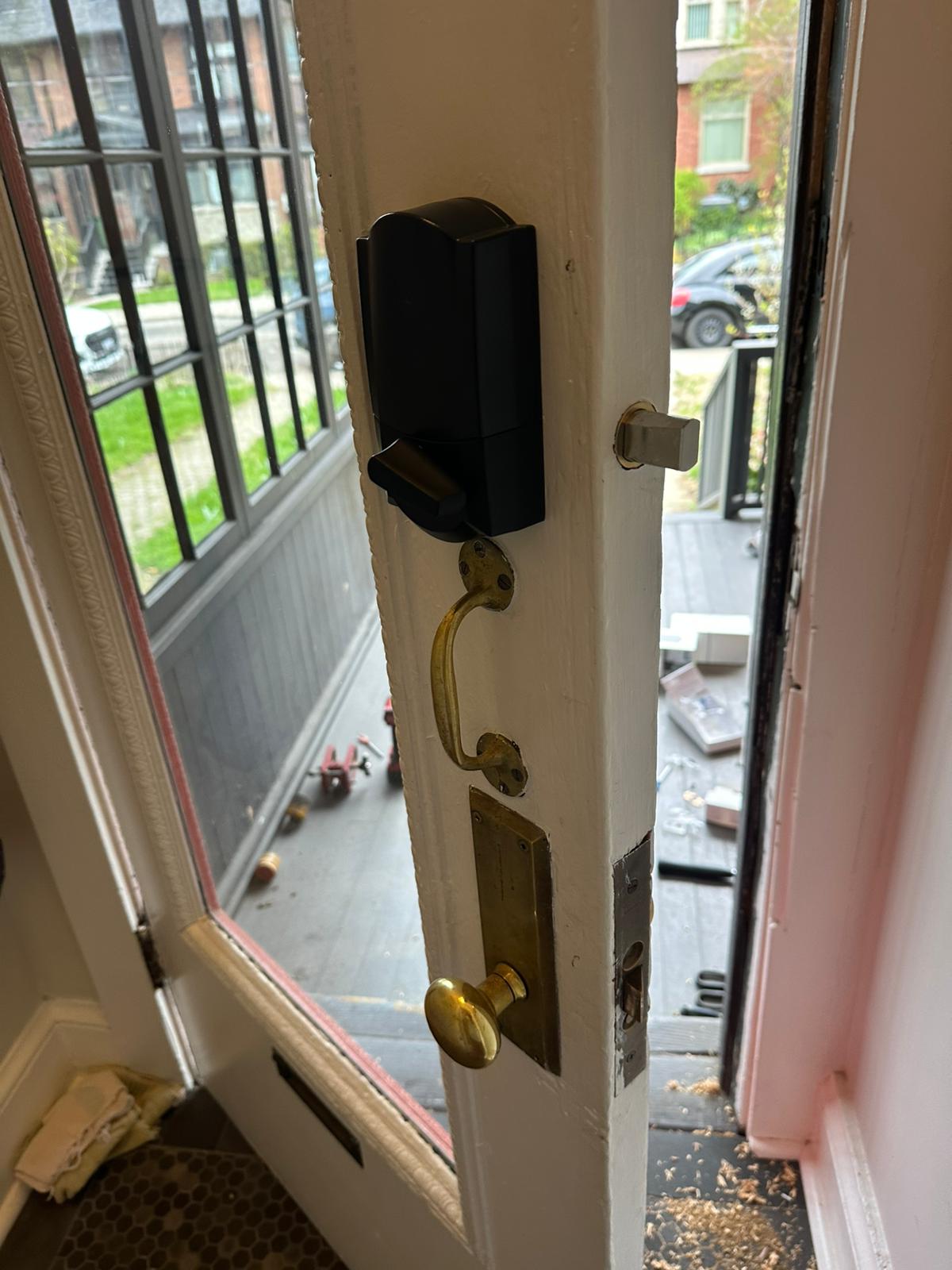
A keypad deadbolt removes the key from the equation: each carer can have a code, codes can be removed, and there is nothing physical to lose. It needs batteries, a maintenance routine and a mechanical override key kept somewhere sensible; see keypad locks and easier-to-use door hardware for seniors.
Some households use a keypad on the door and keep a key safe as a backup for emergencies, which covers battery failure without depending on the box daily.
For buildings with a concierge, the building's own arrangements may be simpler and more controlled.
In a condominium, a key safe on a suite door or in a common corridor is usually subject to the corporation's rules, and many do not allow fixings on common-element walls.
Ask the property manager first. Some buildings hold a suite key for this purpose, or have an arrangement with care agencies. Suite doors carry the same constraints as during apartment and condo lockouts.
Fobs remain the building's to issue; a key safe holds a mechanical key, not a fob that the corporation controls. See lost condo fob or building key.
At the end of a care arrangement, change the code and consider whether the box should stay. If it is no longer needed, remove it and make the wall good.
If the resident has moved, or after a death in the family, the key safe forms part of the same review as the door locks; see locks after a death in the family. Codes given to agencies over a long period are rarely recalled accurately, so a change is the reliable step.
Paramedics and firefighters have their own methods and do not wait for a code. A key safe can help when someone has called for help and cannot open the door, but do not rely on it as a plan. If someone inside needs medical help, call 911 and tell them the situation and, if you have it, the code.
If someone inside may need help, the situation belongs with 911 rather than a locksmith, as with someone locked inside a room or home.
We can fit a key safe securely in a sensible location, cut a key limited to the door the carers use, rekey cylinders so the box key opens only what it should, fit keypad hardware where that suits better, and change or remove the arrangement when care ends.
We can also check that the door itself closes and latches properly, which matters when several people use it every day.
Care arrangements change more often than people expect: agencies change staff, a second service starts, a family member takes over some visits. Each change is a reason to look at the code and the list of who has it.
Set a reminder every few months to ask two questions: who currently has this code, and does each of them still need it? If the answer to the second is no for anyone, change the code and give the new one only to the people still attending. It takes minutes and keeps the arrangement from drifting into something nobody controls.
It also helps to write down the arrangement in one place: which door the box serves, who currently has the code, when it was last changed, and who to contact at each agency. Keep that note with the resident's other care information rather than beside the door, so anyone stepping in to help, including a family member arriving from out of town, can see how access works without having to phone around. Review that note whenever the care plan changes, and make sure the person coordinating care knows it exists. Care arrangements often pass between family members at short notice, and the person taking over rarely inherits the detail of who was given which code and when, which is precisely when an old code quietly stays in use far longer than anyone intended.
When you call, tell us the door, who needs access, whether an agency has specified a particular box, and whether the property is a house or an apartment.
Keep reading
It is secure enough for its purpose when it is chosen, mounted and managed properly: an outdoor-rated box fixed into solid material, out of direct view from the street, with a code that is changed when the care arrangement changes. It becomes insecure when the code is shared endlessly and never changed, or when the box is screwed into siding where it can be levered off. The management matters more than the model.
It is secure enough for its purpose when it is chosen, mounted and managed properly: an outdoor-rated box fixed into solid material, out of direct view from the street, with a code that is changed when the care arrangement changes. It becomes insecure when the code is shared endlessly and never changed, or when the box is screwed into siding where it can be levered off. The management matters more than the model.
Beside the door but out of direct sight from the street: around a corner, behind a porch post or on a side wall. Fix it into masonry or framing rather than siding alone, using the fixings supplied. Do not label it with the address or the resident's name, and do not choose a spot where someone could work on it unseen for several minutes.
Only the people who currently need it: the care agency, the specific workers attending and perhaps a family member. Give it directly rather than posting it in a family group chat where it stays searchable for years. Keep a note of who has been given it and when. Change it when the agency changes staff, when the care arrangement changes, and periodically in any case.
No. Use a key that opens the door the carers actually use and nothing more. Compatible cylinders can be rekeyed so the box key is limited to that door. Never put a car key, garage remote, safe key or a key to another property in the box. One key, one purpose, is the rule that keeps a key safe from becoming a single point of failure for the whole household.
Often, yes. Each carer can have their own code, codes can be removed when someone stops attending, and there is nothing physical to lose or return. It needs batteries replaced on a schedule and a mechanical override key kept somewhere sensible. Some households use both: a keypad for daily access and a key safe as a backup for battery failure or for emergency services.
Ask the property manager first. Many corporations do not allow fixings on common-element walls or doors, and some have their own arrangement with care agencies or hold a suite key for this purpose. Rules vary between buildings. Remember that a key safe holds a mechanical key; building fobs are issued and deactivated by the corporation and cannot be handled the same way.
They have their own methods and will not wait for a code if someone needs medical help. A key safe can help when a person has called for assistance and cannot reach the door, and you can give the code to the 911 operator, but it should never be the plan you rely on. If someone inside needs help, call 911 first and mention the box and its code if you have them.
Change the code straight away, and decide whether the box should stay. If it is no longer needed, remove it and make the wall good. Codes given to agencies and individual workers over months or years are rarely recalled accurately, so a change is the reliable step rather than assuming the code is still private. If the resident has moved or died, treat the box as part of the wider review of who holds access.
GTA Lockman Mobile Locksmith Services is a mobile locksmith working on homes, businesses and vehicles across Toronto and the GTA, with more than 14 years in the trade. Every review is written by a customer on Google, where you can read them in full.
Areas served: Toronto, North York, Scarborough, Etobicoke, Vaughan, Richmond Hill, Markham, Stouffville, Newmarket, Mississauga, Brampton, Oakville, Milton, Halton Hills, Pickering, Ajax, Whitby, Oshawa, Uxbridge.
Describe the door, hardware and service address. Contact GTA Lockman Mobile Locksmith Services to confirm the scope and scheduling for your location.