Locksmith services are always 10% off for seniors.
Open Mon–Thu 8:30 AM–9 PM, Fri 8:30 AM–4 PM, Sun 9:30 AM–9 PM
Locksmith services are always 10% off for seniors.
Open Mon–Thu 8:30 AM–9 PM, Fri 8:30 AM–4 PM, Sun 9:30 AM–9 PM
GTA Lockman Mobile Locksmith Services · Toronto & GTA
Why the core of a door decides how well it holds a lock, and when to upgrade to solid-core.
Related services
Separate the working part of the home from the living part, for clients, stock, records and deliveries.
Learn moreLocks, closers and keying for the door between two households in a divided house.
Learn moreSolid doors, keyed or keypad deadbolts and damp-proof hardware for cellars, workshops and storage rooms.
Learn moreCover, plug or reinforce the holes old hardware leaves behind, so the door stays strong at the lock.
Learn moreKeep fire doors latching and exits releasing, with hardware suited to the assembly and no added bolts.
Learn moreKeep track of who holds keys in a shared house, and handle bedroom doors and move-outs properly.
Learn more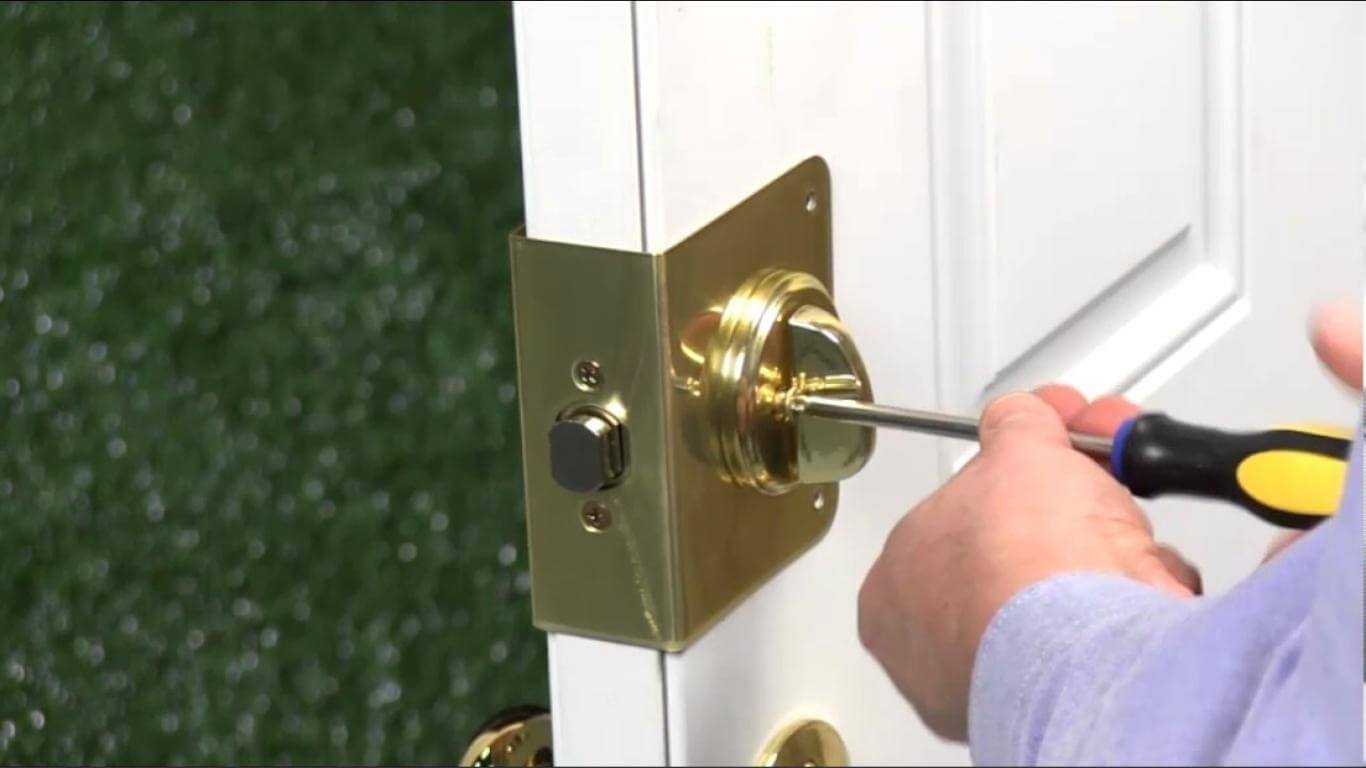
From the outside, a hollow-core door and a solid-core door can look identical: the same panel design, the same paint, the same hardware. Knock on them and the difference is obvious. A hollow-core door sounds hollow and feels light; a solid-core door sounds dull and feels heavy.
That difference affects sound, durability, fire resistance and, most of all, how well the door holds a lock.
A hollow-core door is a light frame of wood around the edges, with thin skins of hardboard or plywood on each face. The inside is mostly empty, often filled with a cardboard honeycomb to keep the skins from flexing. Solid wood is found only around the edges and in a lock block, a small solid section where the lock is meant to go.
Hollow-core doors are inexpensive and light, which makes them the standard for interior doors in most homes: bedrooms, bathrooms, closets and hallways.
Their weaknesses:
A solid-core door has a core of composite wood, particleboard or similar material filling the whole door, with veneer or hardboard skins. It is much heavier, much harder to break through, quieter and more fire resistant than a hollow-core door.
Solid wood doors, made of solid timber throughout, are another option, common on older homes and on higher-end new doors.
Exterior doors are typically solid-core wood, solid wood, insulated steel or fibreglass, never hollow-core.
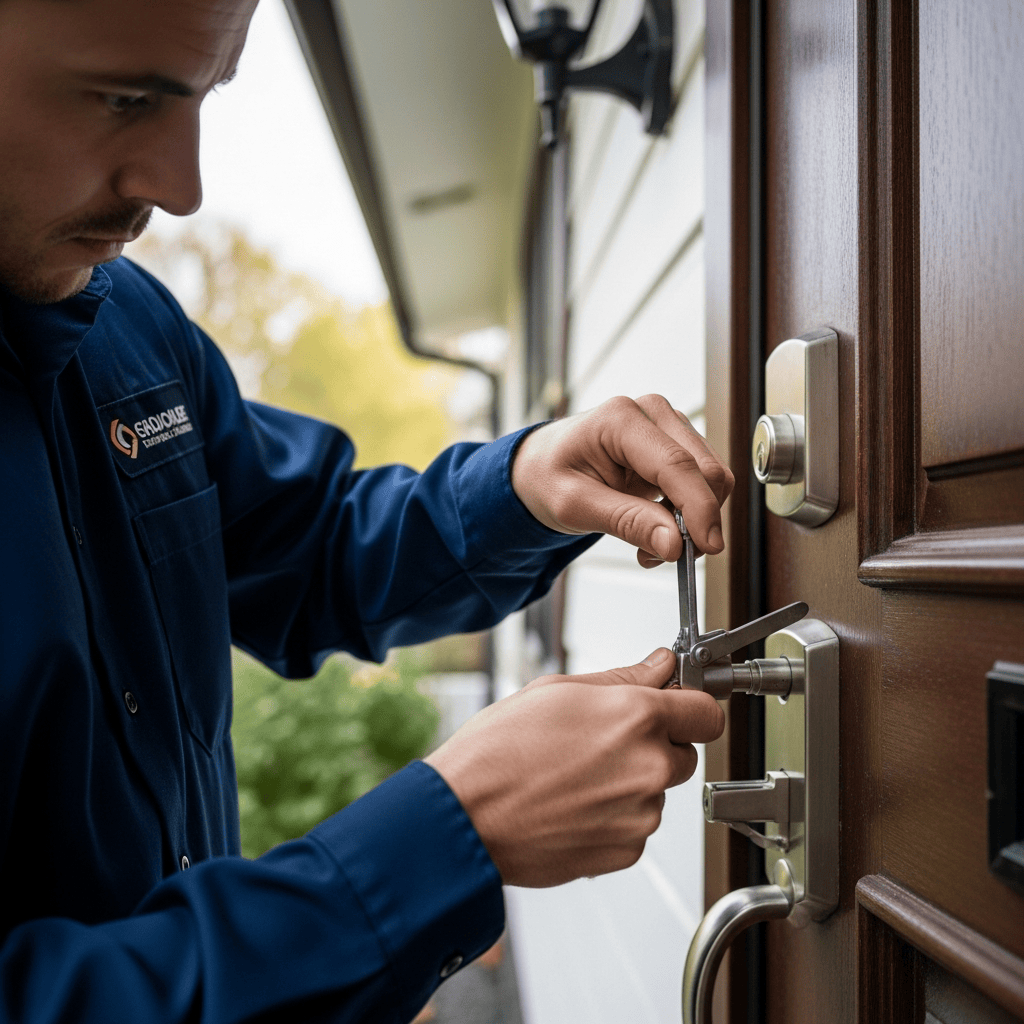
A lock is only as strong as the door around it. A deadbolt fitted to a hollow-core door adds little real security, because the door itself can be broken through. For any room that genuinely needs to be locked, such as a home office with client files, a storage room or a suite door in a shared house, the door needs to be solid-core.
Hollow-core doors have limited lock positions. The lock block is usually on one side only, at standard handle height. Fitting a lock elsewhere means drilling into empty space with nothing to hold the hardware. Changing the handing of a hollow-core door can leave the lock with no solid block behind it.
Screws pull out. Hinges, closers, door stops and surface bolts screwed into the thin skin of a hollow-core door work loose. Through-bolts or fixings into the edge frame hold better.
Replacing a hollow-core slab with a solid-core slab of the same size is usually straightforward. The new slab is fitted to the existing frame and hinges, and the hardware is moved across or replaced. Because solid-core doors are heavier, check that the hinges and frame can carry the weight; a third hinge or longer hinge screws are often added.
A pre-hung solid-core door, supplied with its own frame, is an alternative where the existing frame is damaged or out of square.
Hollow-core doors damaged by a lock change or a forced entry are hard to repair well, because there is little material to fix into. Small holes can be patched, and a solid block can be glued inside before patching. For larger damage, replacement is usually cheaper and better. Holes left over from previous hardware are dealt with in the same way as other old lock holes.
Some doors must be fire-rated: the door between an attached garage and the house in many homes, suite doors in apartment buildings, and many commercial doors. Fire-rated doors have a mineral or specially treated core and must be fitted with hardware that keeps the rating, including a closer or spring hinges where required. A hollow-core door must never replace a fire-rated door. Businesses face stricter rules, and closers, latches and labels all matter with fire door hardware for businesses.
On hollow-core doors, keep to standard hardware fitted to the lock block: passage and privacy sets, with light hinges. On solid-core doors, keyed locks, deadbolts and heavier hinges all hold properly, and closers can be fitted securely. For any door that is to be locked against other people, start with a solid-core door.
Hollow-core doors are not made for exterior use. They warp with moisture, offer no security and no insulation. If an exterior door, including a door between a garage and the house or a basement entrance, turns out to be hollow-core, it should be replaced with a proper exterior door, solid-core, insulated steel or fibreglass, before anything else is done to the lock.
In rooming houses, student rentals and shared homes where each occupant locks their own room, hollow-core bedroom doors with keyed locks are common, and they are easily broken. Solid-core doors with keyed locks, fitted with a reinforced strike, give occupants real privacy and protect belongings. Locks on rented rooms raise their own questions about consent and access, which apply to student rentals and shared houses.
A solid-core door is the single most effective way to reduce sound between rooms. Adding weather-stripping around the frame and a door bottom seal improves it further. For home offices, nurseries and bedrooms next to living areas, the change is noticeable.
Solid-core doors weigh considerably more, and lightweight hinges and frames may struggle. Three hinges, with long screws into the framing, are usual. Closers, if fitted, need to be sized for the heavier door. Interior door stops should be sturdier too, since a heavy door swinging into a wall can damage it.
Hollow-core and solid-core doors can look identical once painted. When replacing a slab, matching the panel profile and finish of the other doors in the house keeps the change invisible, and the hardware can be moved across or replaced to match.
The order matters. Decide what the door needs to do first: privacy, sound, security, fire resistance. Choose the door to suit. Then choose the lock. Fitting a strong lock to a weak door, or a light lock to a fire door, misses the point either way.
Insurers rarely ask about interior doors, but a home office or room holding valuable items behind a hollow-core door gives little real protection. If something valuable is stored in a room, a solid-core door with a keyed lock is a reasonable step, and noting it in your records can help with a claim. The documentation habits that support home insurance lock requirements apply here too.
In houses, the main fire separation is usually between an attached garage and the living space. The door there should be solid or fire-rated, with self-closing hardware so it shuts and latches. Replacing it with a hollow-core interior door, even temporarily, removes that separation.
For most homes, the upgrade order that gives the most value is:
Any of these suggests the door is not up to the job it is being asked to do, and that a solid-core replacement would serve better.
Finished basements often have hollow-core doors fitted during the renovation, including doors to furnace rooms, storage rooms and bedrooms. Where a basement room is used as a bedroom, an office or a rental space, upgrading its door to solid-core improves privacy, security and sound.
Replacing a slab means matching the size, the hinge positions and the lock preparation of the old door. A slab that is slightly too large has to be trimmed; one too small leaves gaps. Pre-bored slabs simplify the lock work, but hinge mortises often need cutting to match the frame.
Tell us which door, whether you think it is hollow or solid, and what you want it to do: lock, close on its own, keep sound out or resist fire. Photographs of the door and its edge help.
We can advise whether a door can hold the lock you want, fit locks to solid-core and fire-rated doors, reinforce frames and hinges, and fit hardware after a slab is replaced. Household work is part of our residential locksmith services.
Keep reading
Knock on the middle of a panel. A hollow-core door sounds hollow and feels light; a solid-core door sounds dull and is noticeably heavy.
Knock on the middle of a panel. A hollow-core door sounds hollow and feels light; a solid-core door sounds dull and is noticeably heavy.
You can, but it adds little security, because the door itself can be broken through. For a room that genuinely needs locking, use a solid-core door.
Only where the solid lock block is, usually at standard handle height on one side. Elsewhere there is nothing solid to hold the hardware.
Usually yes. A solid-core slab of the same size can be fitted to the existing frame. Because it is heavier, a third hinge or longer screws are often added.
Often a solid-core or fire-rated door with self-closing hardware is required there. Check your local building requirements.
Small holes can be patched, sometimes with a solid block glued inside. Larger damage usually makes replacement the better choice.
Yes. Their mass blocks sound far better than hollow-core doors, which is why they suit bedrooms, bathrooms and offices.
No. Fire-rated doors must be replaced with doors of the same rating, fitted with hardware that keeps the rating.
GTA Lockman Mobile Locksmith Services is a mobile locksmith working on homes, businesses and vehicles across Toronto and the GTA, in the trade since 2010. Every review is written by a customer on Google, where you can read them in full.
Areas served: Toronto, North York, Scarborough, Etobicoke, Vaughan, Richmond Hill, Markham, Stouffville, Newmarket, Mississauga, Brampton, Oakville, Milton, Halton Hills, Pickering, Ajax, Whitby, Oshawa, Uxbridge.
Describe the door, hardware and service address. Contact GTA Lockman Mobile Locksmith Services to confirm the scope and scheduling for your location.