Locksmith services are always 10% off for seniors.
Open Mon–Thu 8:30 AM–9 PM, Fri 8:30 AM–4 PM, Sun 9:30 AM–9 PM
Locksmith services are always 10% off for seniors.
Open Mon–Thu 8:30 AM–9 PM, Fri 8:30 AM–4 PM, Sun 9:30 AM–9 PM
GTA Lockman Mobile Locksmith Services · Toronto & GTA
How rim and mortise cylinders differ, how to tell which you have, and how each is rekeyed or upgraded.
Related services
How a controlled keyway limits copying, what it costs in flexibility, and when an ordinary cylinder is enough.
Learn moreRekeying answers who holds a key; replacement answers whether the hardware suits the door. Compare both.
Learn moreCompare key-control features and compatible hardware upgrades while keeping the surrounding door in the assessment.
Learn moreSecure a forced door, repair damaged locks and frames, and document the work for your police report and insurer.
Learn moreLock and door service for offices, shops and managed properties. Plan access around the way your business operates.
Learn moreWhat to do when the part you need is no longer made, and how to judge a repair against a retrofit.
Learn more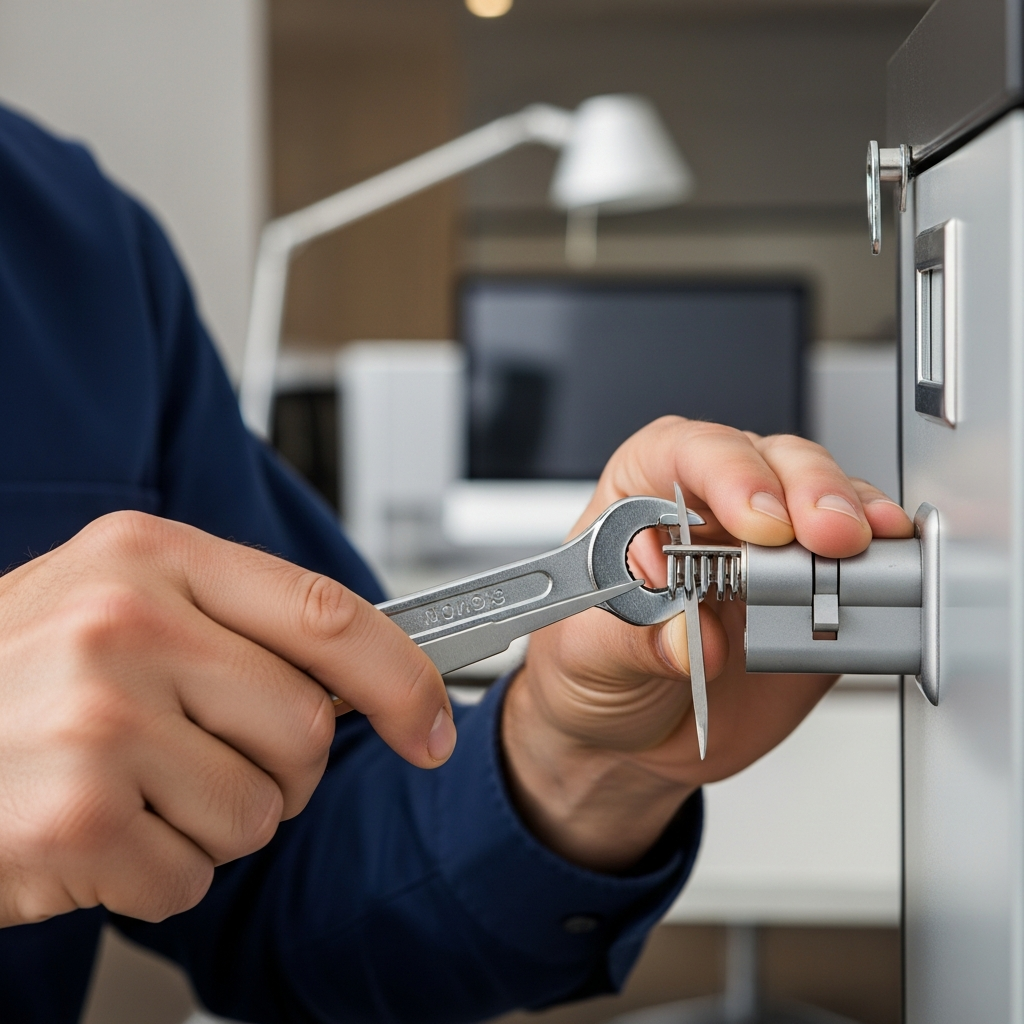
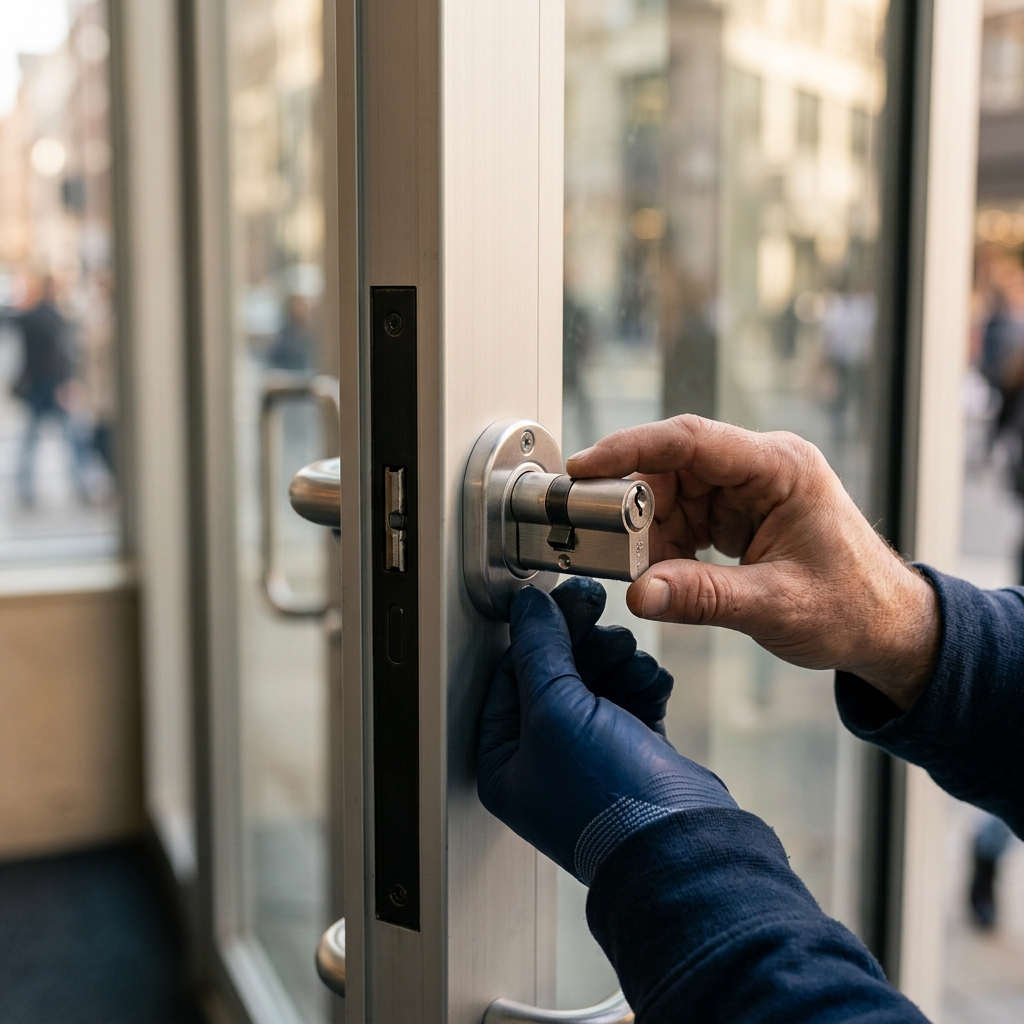
Commercial doors in particular, but also many older homes and apartment buildings, use locks where the cylinder, the part the key goes into, is a separate component from the lock itself. Two common types are rim cylinders and mortise cylinders. They look similar from the outside, but they fit different locks, are fixed in different ways, and are not interchangeable.
Knowing which one a door uses matters when a key is lost, when a building is rekeyed, when a lock is upgraded, or when replacement parts are ordered.
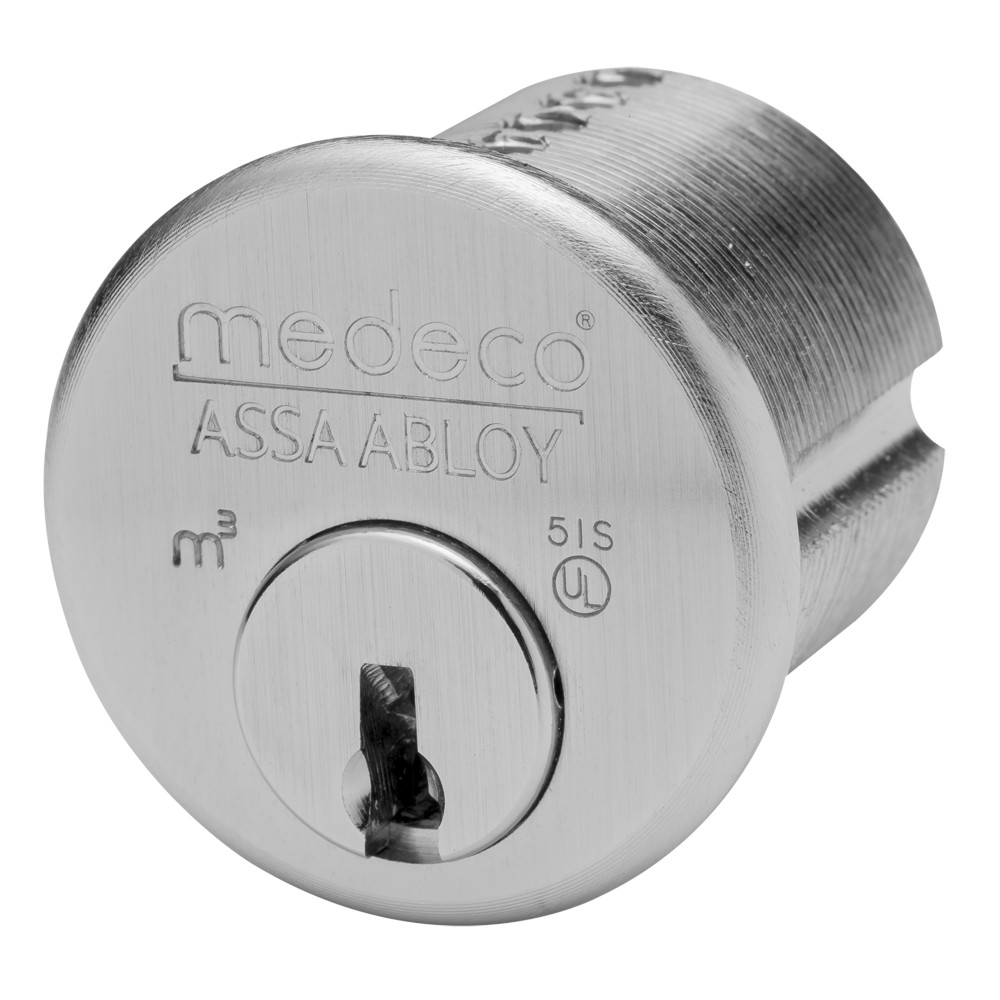
A mortise cylinder is a threaded cylinder that screws into the body of a mortise lock, the box-shaped lock set into a pocket in the door edge. It is held in place by a set screw inside the lock case that bites into a groove along the cylinder's thread. On the back of the cylinder is a cam that operates the lock's bolt and latch.
Mortise cylinders are common on:
They come in different lengths to suit door thickness and trim, and with different cams to suit the lock. Getting the length and cam right is essential: a cylinder that is too long sticks out and is easier to attack, and one with the wrong cam will not operate the lock.
A rim cylinder is a cylinder that passes through the door from the outside and is held by two long screws from the inside, through a back plate. A flat tailpiece on the back of the cylinder extends through the door into a lock mounted on the inside face, such as a rim night latch, a surface deadlock, or the rim exit device on a commercial door.
Rim cylinders are common on:
The tailpiece can usually be cut to length to suit the door thickness, which makes rim cylinders more adaptable than mortise cylinders.
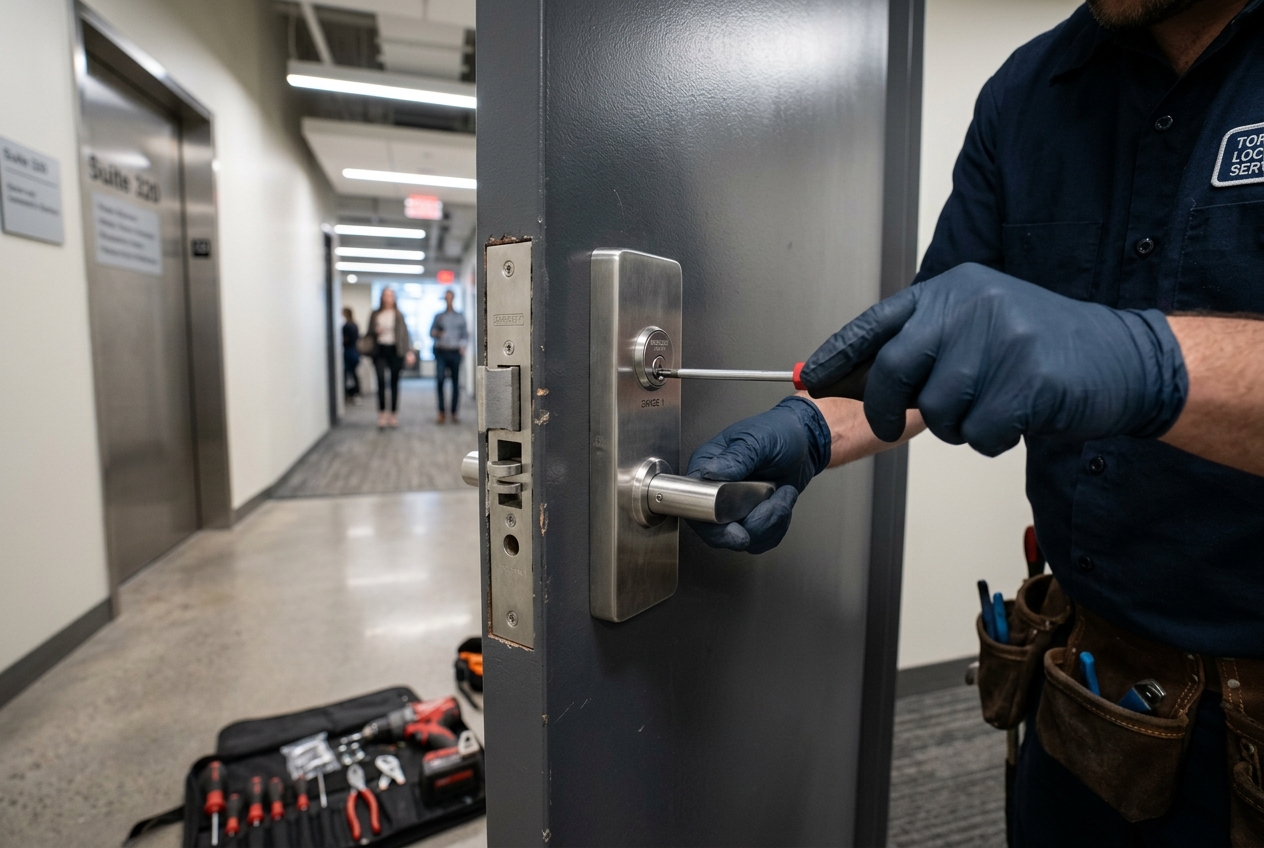
Look at the inside of the door. If the lock is a box mounted on the inside face, with screws holding a back plate around the cylinder, it is probably a rim cylinder. If there is no surface-mounted box and the lock is set into the edge of the door, it is likely a mortise cylinder.
Look at the door edge. A mortise lock has a long faceplate on the edge, often with the cylinder's set screw accessible behind it. A rim lock usually has only a strike or keeper on the frame, not a long faceplate.
On exit devices, outside key access is almost always through a rim cylinder, while mortise exit devices use a mortise cylinder.
Many commercial buildings use interchangeable core cylinders, sometimes called IC or small-format interchangeable cores. These have a removable core that can be taken out with a special control key and replaced in seconds, without removing the cylinder housing. They come in rim, mortise and other housings.
Interchangeable cores make rekeying a large building much reliable, because cores can be prepared in advance and swapped door by door. They are most useful in buildings with many doors and frequent staff changes, and they are often combined with a master key system and restricted keys, as with restricted key systems.
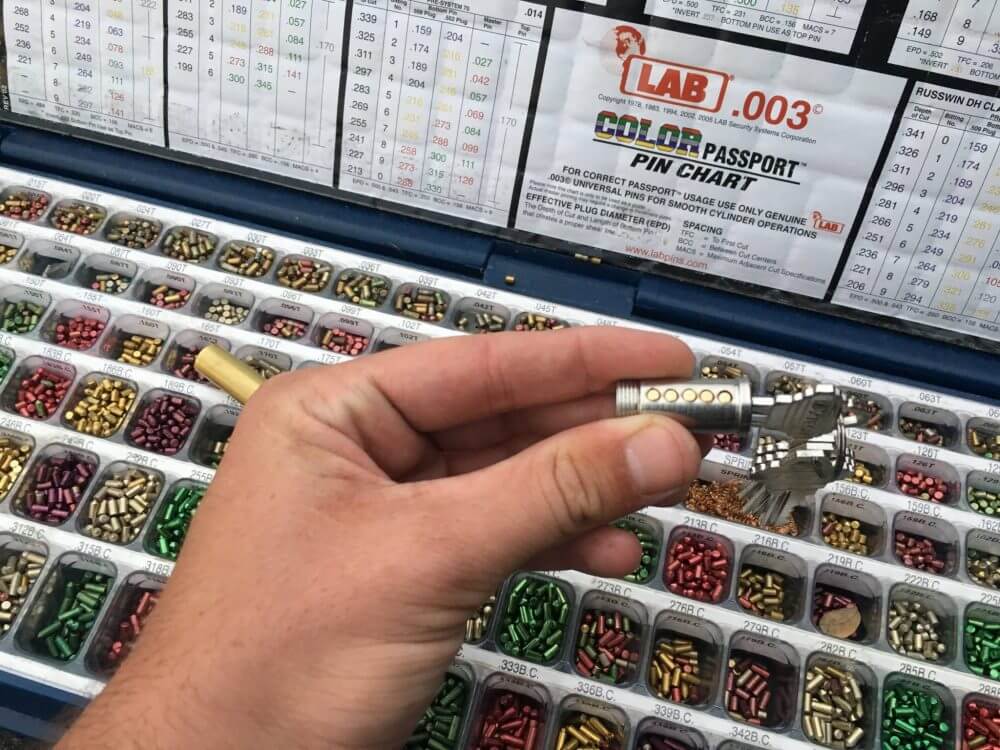
Both types can usually be rekeyed like any other pin tumbler cylinder: the plug is removed, the pins are changed to match a new key, and the cylinder is refitted. For a building, cylinders are often taken out, rekeyed together and refitted, or replaced with pre-keyed cylinders. The principle is the same as in any rekey or replace decision.
One advantage of separate cylinders is that the security of the door can be upgraded by changing only the cylinder. A standard mortise or rim cylinder can be replaced with a high-security version of the same type, adding pick and drill resistance and restricted keys, without touching the lock body. That is often the most economical upgrade on a commercial door, and the features involved are those that define high-security locks.
A cylinder that sticks out from the door face can be gripped, twisted or struck. Cylinder guards, also called collars or rings, protect the cylinder face, and many are tapered or spin freely so they cannot be gripped. On storefronts and rear doors that face the street or a lane, a hardened cylinder guard is a worthwhile addition.
Getting the cylinder length right matters for the same reason. On mortise cylinders, spacer rings and the correct length bring the cylinder face close to flush with the trim.
The key turns but nothing happens. On a mortise cylinder, the cam may be wrong, worn or loose. On a rim cylinder, the tailpiece may be cut too short or not engaging the lock.
The cylinder turns in the door. On a mortise lock, the set screw has loosened, letting the whole cylinder rotate. Tightening it, from behind the faceplate, usually fixes it, and it should be checked after any cylinder change.
The cylinder has been forced. A twisted or broken cylinder needs replacing, and the lock behind it should be checked for damage. The same checks follow any lock repair after a break-in.
Keys work in some doors but not others after a rekey. On master-keyed buildings, the cylinder may have been pinned incorrectly or swapped with another door's cylinder.
When ordering a replacement cylinder, note:
A photograph of the cylinder face, the door edge and the inside of the door usually identifies the type straight away.
Older houses in Toronto sometimes have surface-mounted rim night latches on the front or back door, operated by a rim cylinder, often fitted decades ago as a secondary lock. These latches lock automatically when the door closes, which can lead to lockouts, and many have short bolts that can be slipped. Where the original rim lock is worn, replacing it with a modern deadlocking rim lock, or adding a proper deadbolt, gives better security while keeping the door's character.
Older front doors may also have original mortise locks with cylinders that no longer match any current key. A modern mortise cylinder of the right length and cam can often replace the old one, so the lock can be keyed to the rest of the house.
The cam on a mortise cylinder and the tailpiece on a rim cylinder are what connect the key to the lock. Different lock makers use different cams: some are a simple straight bar, others a cloverleaf, others specific to a particular manufacturer. A cylinder with the wrong cam may turn but fail to operate the lock, or may jam it. When replacing cylinders, the safest approach is to match the cam to the lock body, or to keep the existing cam if the new cylinder allows it to be transferred.
Rim tailpieces are usually cut to length on site. A tailpiece that is too long can bind against the lock; one that is too short may not engage at all.
In a building with many doors, a simple list noting which doors use rim cylinders, which use mortise cylinders, the lengths and the cams, saves a great deal of time when a cylinder needs replacing or the building is rekeyed. It also helps with ordering spare cylinders that can be swapped in when a key is lost.
Gates, sheds and outbuildings often use rim cylinders on surface-mounted locks, or padlocks. Fitting rim cylinders keyed to the house key means one key opens the house, the gate and the shed, which cuts down the number of keys to manage. Outdoor cylinders benefit from a weather cover and a dry lubricant before winter, since water and ice inside the cylinder are the most common cause of failure.
When the whole lock is being replaced, the choice between a surface-mounted rim lock and a mortise lock depends on the door. A mortise lock is stronger and neater on a door thick enough to take it; a rim lock suits thinner doors and outbuildings where cutting a deep pocket is not practical.
Cylinders come in finishes to match the door hardware, such as satin chrome, brass and bronze. On a storefront or entrance where the cylinder is visible, matching the finish keeps the door looking finished after a cylinder change.
Tell us what kind of door it is, whether the cylinder is rim or mortise if you know, and what you need: a rekey, a replacement, an upgrade or a cylinder guard. Photographs help.
We can rekey, replace and upgrade rim and mortise cylinders, set up interchangeable cores, fit cylinder guards and match cylinders to an existing master key system. Building and storefront work is part of our commercial locksmith services, and household doors are part of our residential locksmith services.
Keep reading
A mortise cylinder screws into the body of a mortise lock set in the door edge. A rim cylinder passes through the door and is held by screws from the inside, with a tailpiece that operates a surface-mounted lock or exit device.
A mortise cylinder screws into the body of a mortise lock set in the door edge. A rim cylinder passes through the door and is held by screws from the inside, with a tailpiece that operates a surface-mounted lock or exit device.
If there is a lock box mounted on the inside face of the door, it is probably a rim cylinder. If the lock is set into the door edge with a long faceplate, it is probably a mortise cylinder.
No. They fit different locks and are fixed differently. The replacement must be the same type, with the right length and cam or tailpiece.
The set screw inside the lock case has loosened. Tightening it, from behind the faceplate, stops the cylinder rotating.
Yes. Both rim and mortise cylinders can usually be rekeyed like any pin tumbler cylinder, or replaced with pre-keyed cylinders.
A removable core that can be swapped with a control key without removing the cylinder housing. It makes rekeying large buildings much reliable.
Often yes. A standard rim or mortise cylinder can be replaced with a high-security cylinder of the same type, adding pick and drill resistance and restricted keys.
A protective ring or collar around the cylinder face that stops it being gripped or twisted. It is useful on storefronts and rear doors.
GTA Lockman Mobile Locksmith Services is a mobile locksmith working on homes, businesses and vehicles across Toronto and the GTA, with more than 14 years in the trade. Every review is written by a customer on Google, where you can read them in full.
Areas served: Toronto, North York, Scarborough, Etobicoke, Vaughan, Richmond Hill, Markham, Stouffville, Newmarket, Mississauga, Brampton, Oakville, Milton, Halton Hills, Pickering, Ajax, Whitby, Oshawa, Uxbridge.
Describe the door, hardware and service address. Contact GTA Lockman Mobile Locksmith Services to confirm the scope and scheduling for your location.